
Quick Answer
Hilight uses product information modeling, multi-view asset references, digital-presenter constraints, and multi-agent review to reduce visual drift across frames, shots, and scenes. Instead of focusing only on single-generation speed, Hilight pays more attention to whether a video can be reused, revised, and carried forward in a production workflow. This article explains how Hilight addresses subject consistency, generation efficiency, and rework costs in AI marketing video production.
For ecommerce marketing teams, the hard part is often not generating one video. It is keeping the product from changing shape across angles, keeping the presenter stable across shots, and avoiding another round of manual fixes after each output.
That is why Hilight focuses on subject consistency and workflow control. For videos that need to be reused, revised, and scaled across campaigns, generation speed is only one metric. The more practical question is whether each output can keep moving through production.
AI Marketing Video: Clear Value, but Stable Delivery Remains a Challenge
Looking at the evolution of AI over the past few years, one direction is becoming clear:
At the modality level, capabilities have expanded from text to images, video, audio, and other formats.
At the application level, the focus is shifting from general-purpose capabilities to vertical use cases.
At the system level, AI is moving from generative AI toward agentic AI that can break down tasks, plan, and execute.
Along this path, marketing video generation remains one of the hardest problems to solve and one of the most commercially valuable.
First, video is inherently more complex than other content formats.
Unlike text or images, video is a tightly coupled system in which visuals, people, products, pacing, camera movement, emotion, and sound all coexist. A mistake in any one dimension can quickly become obvious in the finished video.
In marketing scenarios especially, subject consistency, plausible movement, pacing, and shot-to-shot logic are all essential.
Second, the cost of producing marketing videos has remained persistently high.
Traditional production often requires repeated coordination and revisions among models, camera crews, and editors, with timelines commonly measured in weeks. International marketing adds the need to adapt versions across languages and cultures.
That difficulty and cost also point to clear commercial value.
Now that short-form video has become a mainstream information format, a high-quality marketing video remains one of the most efficient ways to communicate product value. As a result, businesses continue to need video content at high frequency, in large volumes, and on an ongoing basis.
That demand has brought a large number of AI products into the marketing video category.
In sustained commercial production, however, different types of AI video solutions may still run into inconsistent results, frequent rework, and costs that are difficult to control.
When a workflow mainly relies on general-purpose models, the process controls required for marketing scenarios often need additional support.
When a workflow is closer to clip assembly, content structures can become repetitive unless creative planning and asset management are strong enough.
When subject consistency and detail logic are not stable, teams need more manual revision, which increases the overall cost of production.
In other words, AI marketing video does not only need to answer "can it generate?" It also needs to answer "can it consistently deliver content that teams can keep using?"
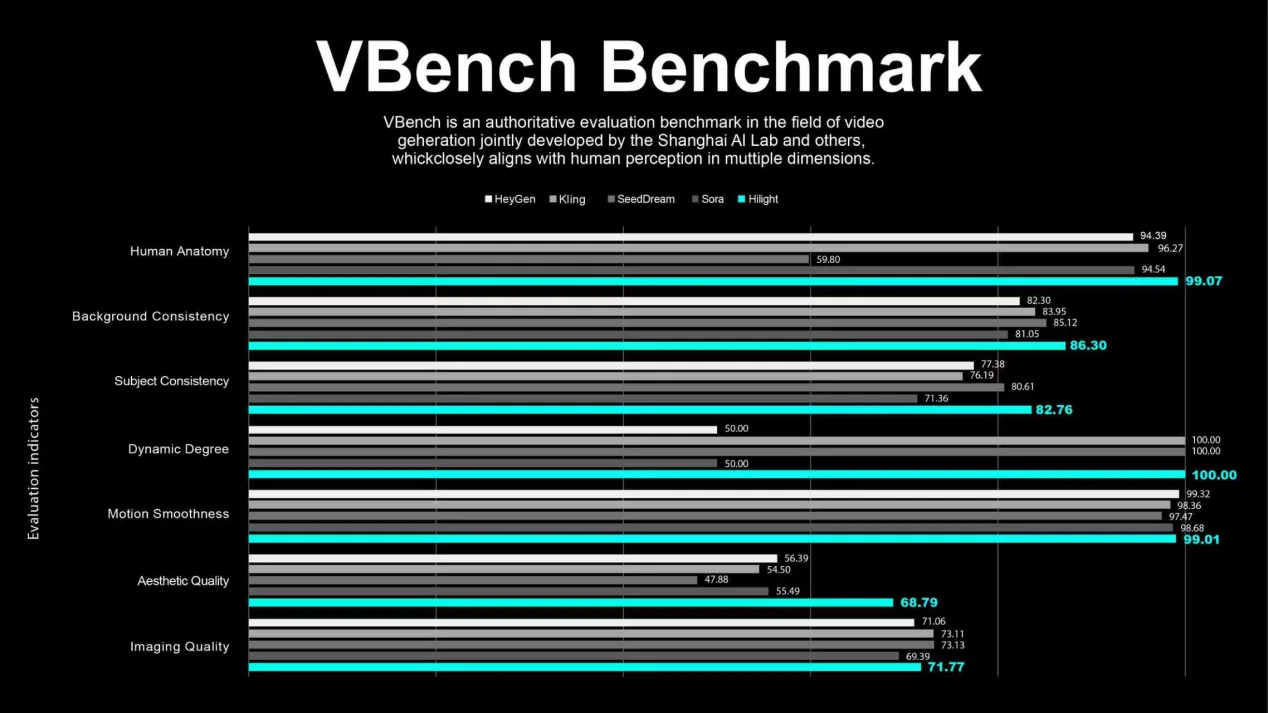
Hilight, developed by the Yingsai AI team, is an AI-native marketing video agent focused on subject consistency for products and people. In selected scenarios, it aims for a visual result that comes closer to live-action footage. Its published VBench results show strong performance across several dimensions, which is why Hilight is often discussed in relation to high-quality video generation for cross-border ecommerce.
From Frames to Shots:
Subject Consistency Is the Basis of Commercial Delivery
Many earlier AI video tools have struggled to enter stable commercial workflows partly because they could not maintain subject consistency across consecutive frames and shots.
In this article, subject consistency includes both stability across consecutive frames and the preservation of core product or character features after a shot or scene change. If shape, scale, or visual logic drifts, the result can feel artificial and become less useful in a commercial workflow.
In marketing video, cross-shot consistency is the minimum threshold for usability. Without it, generation speed, visual effects, and model specifications are beside the point.
Controlling subject consistency across frames and shots is one of Hilight's main characteristics.
In this insulated tumbler marketing video, the product keeps its core appearance across presenter shots, lifestyle scenes, and product-detail moments:
Behind that result is a complete assurance system built on a knowledge graph, intelligent self-checking, and dynamic correction:
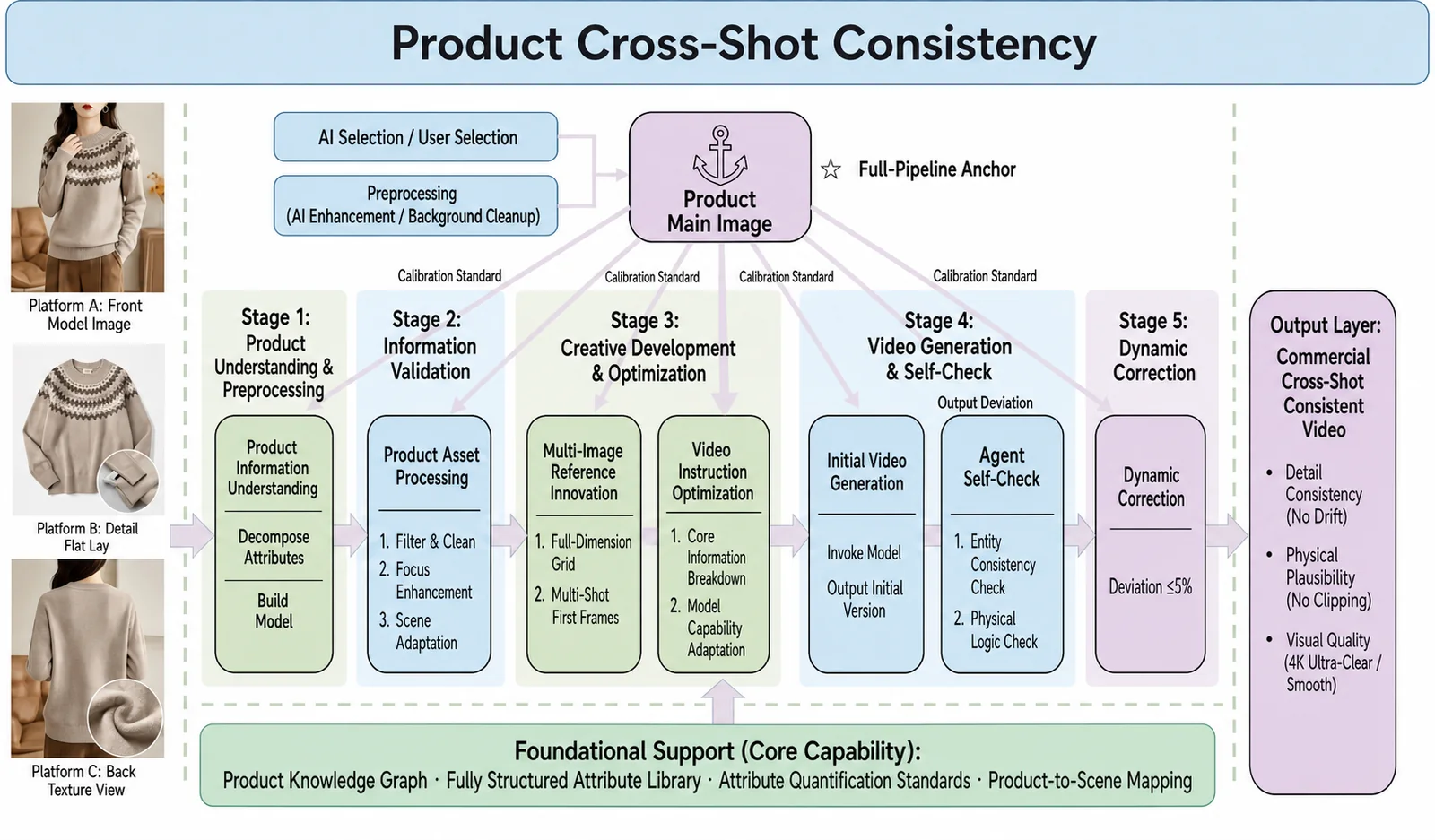
The following five core strategies explain how it works:
Use a Comprehensive Knowledge Graph to Understand Products and Reduce Model Hallucinations
Instead of recognizing only a product name, Hilight breaks each product down into multiple attributes, including material, cut, color, external components, and internal structure. It also tries to describe core selling points and key details as clearly as possible. Whether a shot shows the front, side, or a close-up, the model receives more complete reference information. This reduces the risk of inventing details during generation and provides a standard for later self-checking and correction.
For example, when we upload an image of a suit, this layer can turn it into a description such as: "A suit made from premium wool fabric with a slim overall cut, structured shoulders, sculpted lines, a classic double-breasted design, refined lapels, chest and lower pockets, a dark navy exterior, a light gray lining, lightweight internal support at the shoulders, and moderately padded shoulder pads."
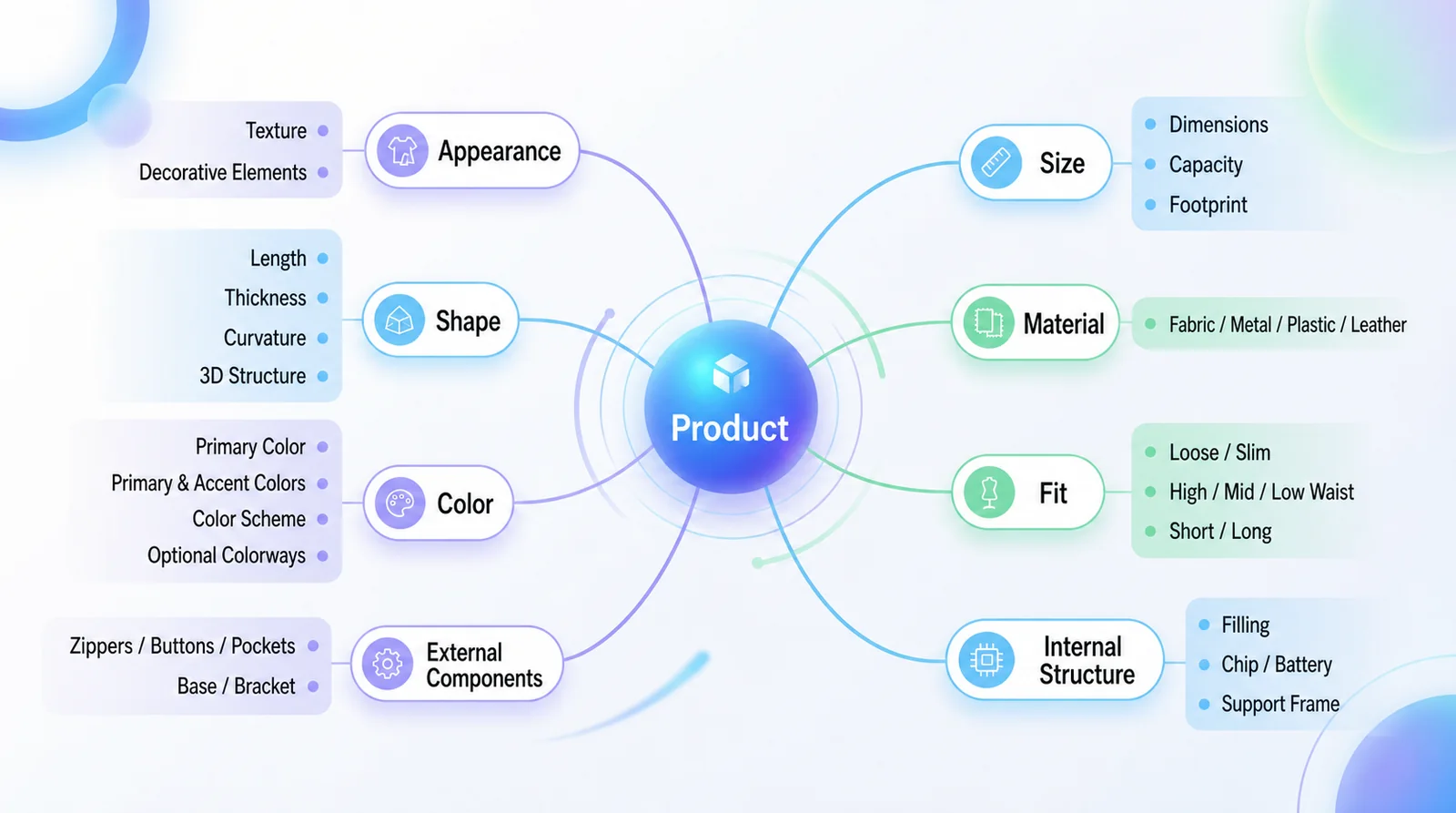
With this information in place, AI can reproduce the product more accurately when planning the script and switching to product close-ups. This prevents feature drift caused by missing information and creates a foundation for cross-shot consistency.
Process Assets at the Shot Level to Handle Multi-Shot Creation
Video generation depends on product assets as well as product information. Hilight supports video creation from an ecommerce product link or a single product image:
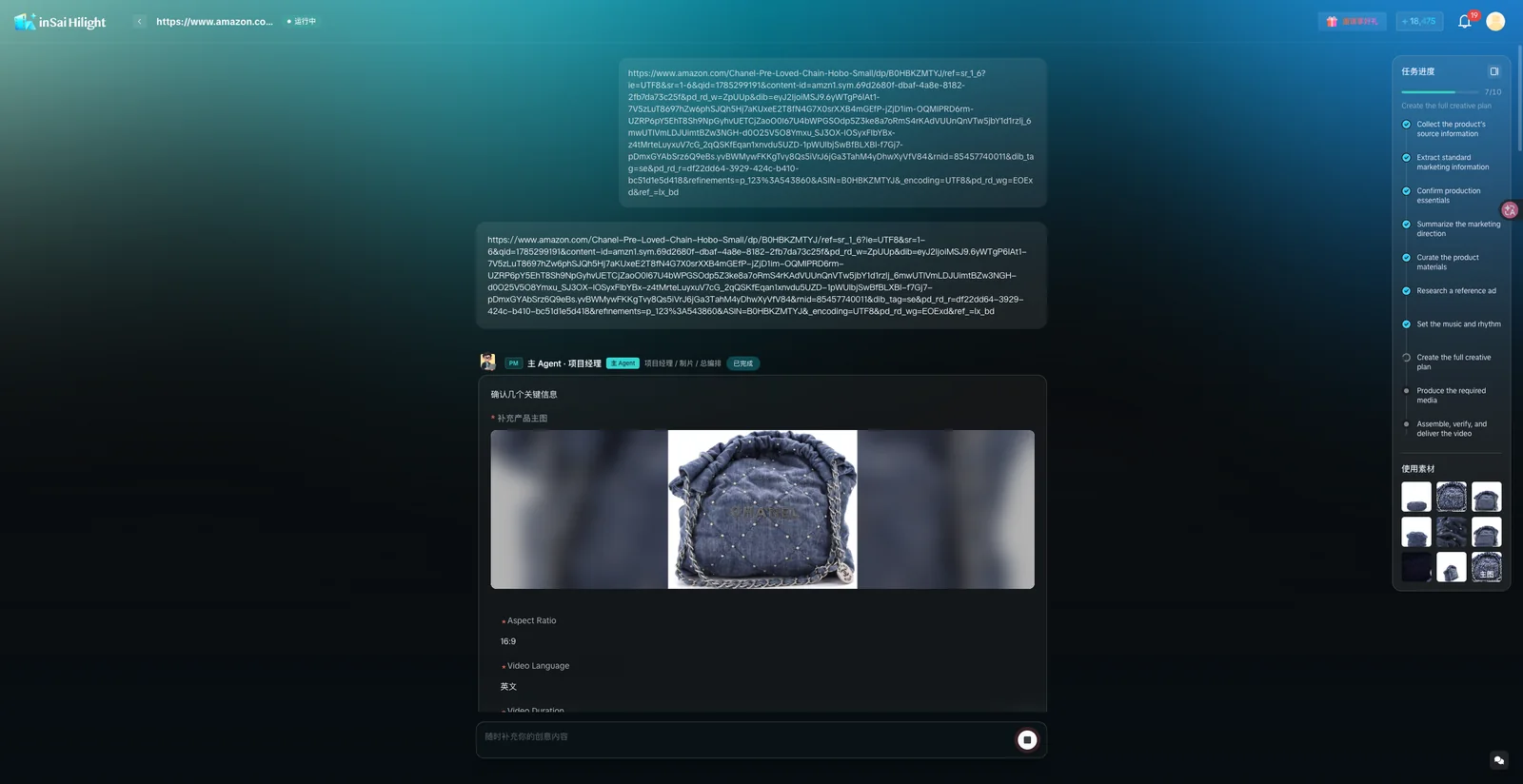
It uses AI to derive and expand assets from the original material, creating a richer asset set while lowering the barrier to production.
Throughout the process, Hilight handles the source assets through filtering and cleanup, focused enhancement, and scene-specific adaptation.
After extracting product-related assets, AI algorithms remove blurry, redundant, cluttered, or distracting low-quality material, retaining only assets in which the product is clear and its features are complete.
Hilight then uses the core selling points, creative concept, and shot requirements to strengthen the most relevant assets, highlight key information, reduce irrelevant background elements, and match each shot with a suitable opening-frame scene.
For a hoodie, for example, different images may show the collar, fit, cuffs, or full outfit. When selecting assets, the system can match each shot with a more relevant reference: a collar close-up when showing warmth, a full-body scene when showing fit, and a snowy outdoor setting when appropriate. This improves individual shot quality while keeping product details and style more consistent throughout the video.
This asset-processing mechanism makes fuller use of available product material, provides a strong base for multi-shot creation, and avoids repetitive or monotonous visuals.
Use Grid-Based Image Inputs to Let the Model See the Whole Product
A short video can contain three to eight shot changes, scene changes, or shifts in selling points within ten seconds. In this kind of content, issues such as deformed objects, clipping, or physically and factually implausible results can still appear.
Take the hoodie example again. If the model receives only a front view, it has to invent the side, back, and on-body appearance, which naturally creates errors.
To address this problem, Hilight uses multi-image stitching and first-frame reference mechanisms. Front, side, back, and detail views are combined into a grid input so the model can refer to more complete product information when generating complex shots. The first-frame reference mechanism also uses the opening frames of consecutive shots as references, creating smoother transitions and reducing visual jumps or misaligned details.
This approach addresses discontinuous product features across multiple shots at the source.
Hilight's grid-based input mechanism:



Apply Strong Constraints to Keep Digital Presenters Consistent
The product is not the only subject that must stay consistent. Hilight also applies strong constraints to digital presenters in the video.
The system creates a dedicated core-identity model for each digital presenter and constrains identity, posture, movement, and scene adaptation. This helps reduce identity drift and distorted motion in AI video.
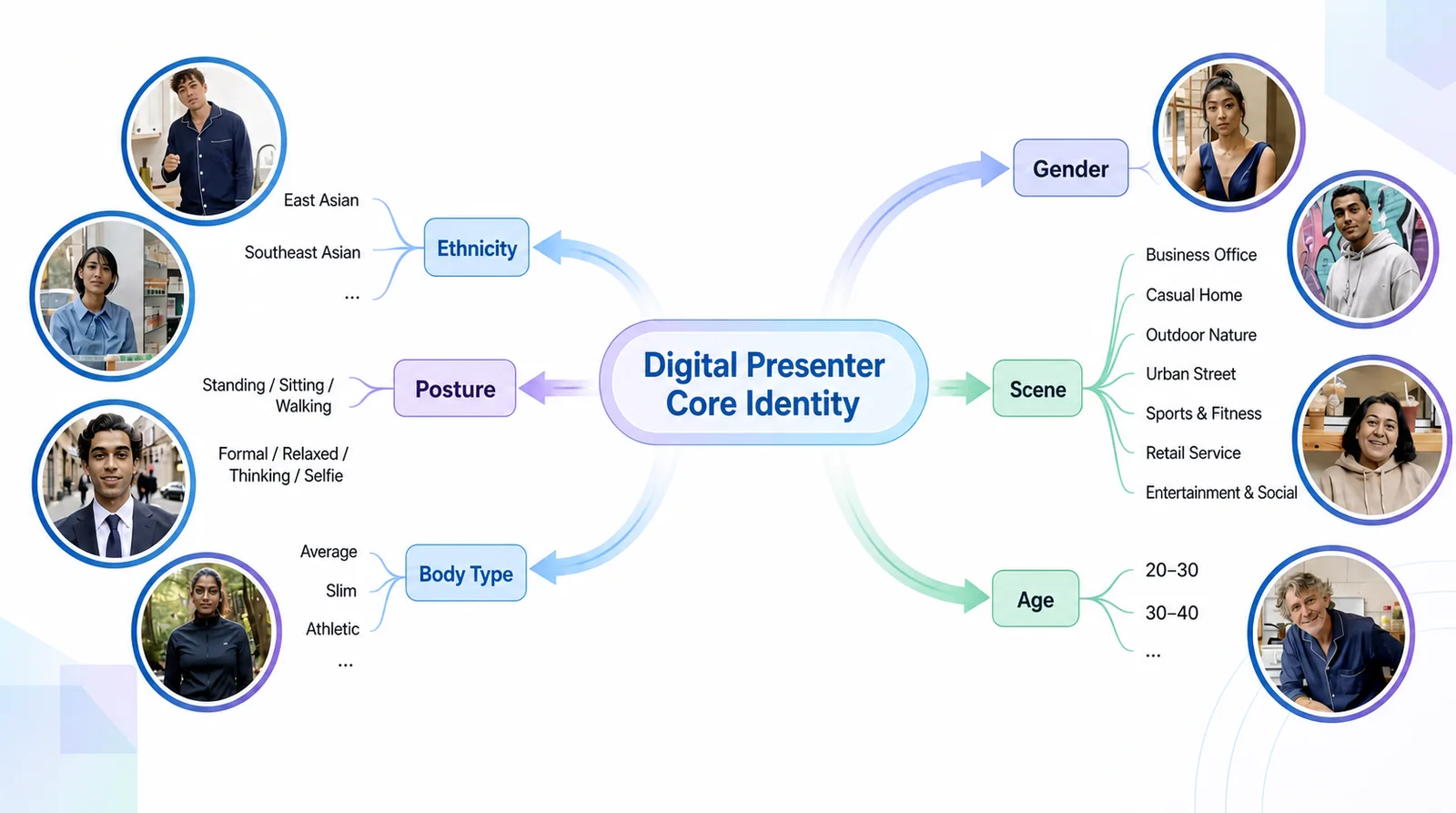
Compared with open-ended generation, this controlled-expression approach is closer to the way models and actors are managed in a real commercial shoot, which helps improve the overall sense of realism.
Hilight also creates a core-identity knowledge base for each digital presenter. It covers identity attributes such as gender, age, and body type; movement attributes such as posture and behavioral characteristics; and scene attributes such as business, casual, and outdoor settings. The system can reuse an existing presenter model or adjust nonessential details dynamically, keeping the baseline fixed while allowing the details to change.
More importantly, multiple agents work together across creative breakdown, presenter selection, and motion generation to keep the presenter aligned with the product and setting. The system can adjust movement or clothing to match the script while checking core features automatically, so the presenter does not become unrecognizable after an action or scene change.
Use Multi-Agent Review as the Final Line of Defense for Consistency
The final safeguard in the workflow is intelligent self-checking and dynamic correction.
Even after earlier optimization, a generated video may contain small errors, such as an incorrectly scaled handheld product, clipping in a person's movement, or inaccurate material details. Hilight therefore uses an intelligent self-checking agent to run two automatic validations after each video segment is generated:
1. Entity consistency check:
The system compares the video's color, cut, material, and key components with the main product image to ensure that core attributes do not drift.
2. Physical logic check:
The system checks whether interactions between people and products are plausible and whether the scene contains clipping, unreasonable occlusion, or violations of common sense.
When the system finds a problem, it can trigger rollback and repair before the result is delivered to the user. In effect, part of the quality control that would otherwise rely on manual review becomes a system capability.
From the perspective of commercial usability, cross-shot consistency is not an optional enhancement. It is the basic threshold that determines whether generated content can move into later production and publishing preparation.
For that reason, Hilight does not treat consistency as a challenge confined to a single generation stage. It has built a systematic mechanism around information completeness, multi-view fusion, and closed-loop validation.
Multi-Agent AI + Slow Thinking
Reframe the Efficiency and Cost of Marketing Video
Only after consistency has been addressed and the content is usable does the next question matter: can generation efficiency and cost meet commercial requirements?
Efficiency here does not mean the speed of a single generation.
A more useful measure of efficiency is the delivery cycle for the entire project, from the initial request to a finished video that can enter publishing preparation. If the process requires repeated rejection, revision, and rework, rapidly generating unusable content only creates more bottlenecks.
Cost also cannot be judged by the price of a single generation. It must be measured as the total cost of obtaining usable content. If unstable results require repeated regeneration and adjustment, a low per-generation price will not reduce the overall cost.
For AI marketing video to fit a commercial workflow, the key is not only how quickly it generates. The key is whether it can deliver usable content more reliably while meeting efficiency and cost constraints.
Based on that principle, Hilight does not focus only on making a single model generate faster. It uses a multi-agent architecture and slow-thinking mode to support a more stable and scalable video production process.
A Multi-Agent Architecture with More Than a Dozen Agents Working in View
See more than a dozen agents deliberate as they work
Many AI video tools still use one model and one prompt as the main generation pattern, which can make results relatively unpredictable. Professional marketing video production, by contrast, requires collaboration, repeated refinement, and more precise control.
Hilight starts from a core belief: professional marketing content is usually not completed in a single generation. It is the result of repeated collaboration among multiple roles.
Instead of designing AI video generation around one model and one prompt, Hilight draws on nearly ten years of real-world video marketing cases to reproduce the collaborative structure of a professional production team and establish a multi-agent architecture for marketing video:
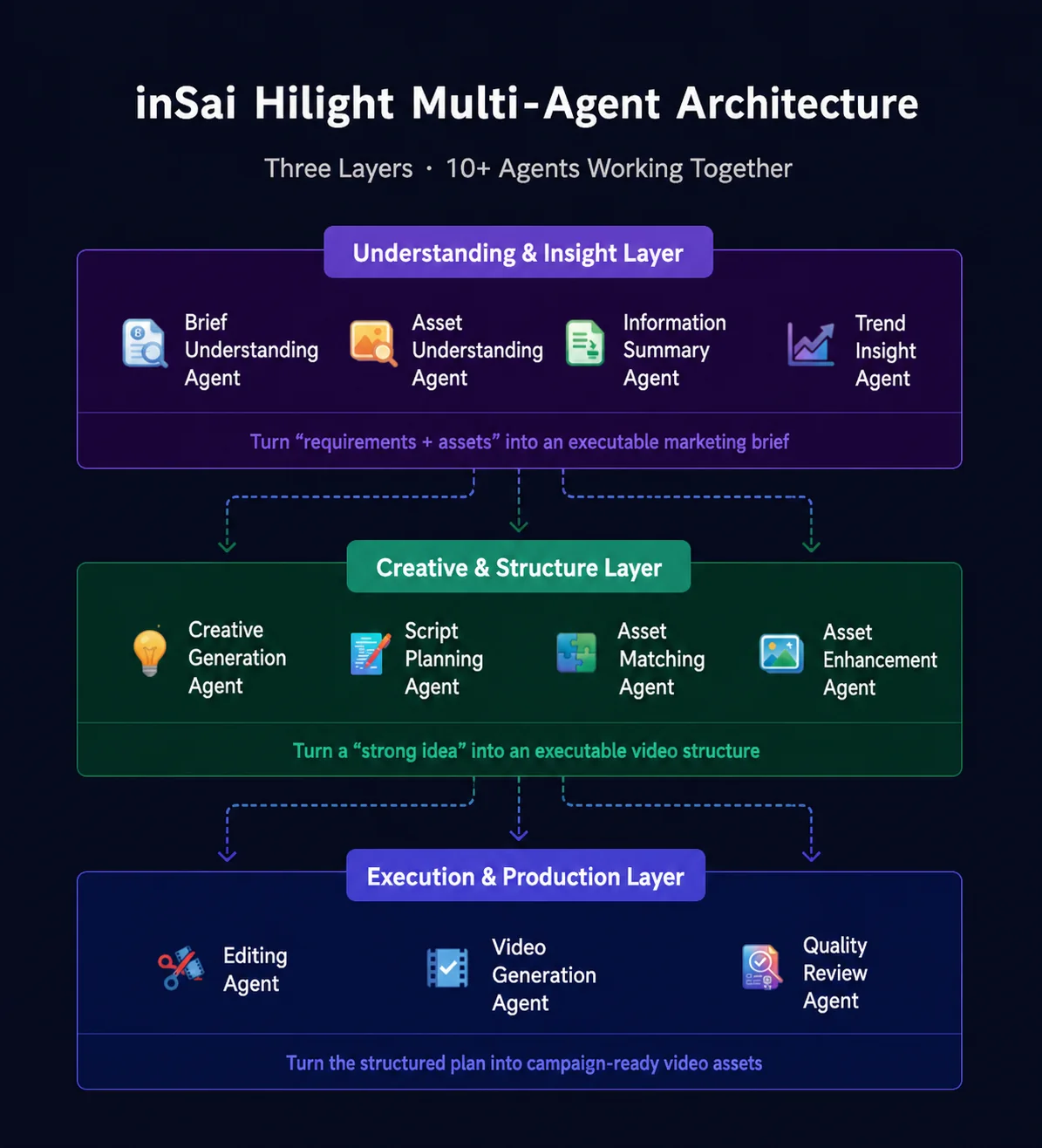
When a video task is submitted in Hilight, multiple agents are scheduled to begin work:
The first stage focuses on understanding the request and the supplied assets. Like a team of planning consultants, the agents translate brand information, product assets, and target audiences into executable instructions. They also consider current platform trends so that the creative direction remains relevant to real campaign performance. This helps product benefits and marketing strategy take shape before production begins.
Next, the creative idea becomes executable. At the creative and structural layer, agents generate narrative angles and visual hooks, break the idea into a practical storyboard, select the most suitable asset for each shot, and improve image quality. This stage acts like an internal rehearsal between a director and art director, keeping every shot aligned with marketing logic, visual standards, and brand tone.
Finally, the execution layer turns the storyboard and assets into campaign-ready video. Editing agents complete timeline-level edits and generate versions for multiple platforms, while quality-control agents review each video for detail and logic issues and feed what they learn back into the system. The result is designed not only to look polished but to be ready for distribution, reducing the cost of repeated manual revisions and checks.
The key to the multi-agent system is not the number of agents, but whether different agents can evaluate results, suggest changes, and trigger rollback when needed. Multiple rounds of collaboration can reduce the risk that an entire result must be discarded after one generation. The system can also adjust creative patterns based on validated content performance and platform rules.
In other words, Hilight does not focus only on a single generation. It aims to establish a more systematic production workflow that helps businesses create content with greater control and move gradually from one-off experiments toward scaled operations.
Slow-Thinking Mode: Evaluate First, Then Generate
In AI video generation, speed is often placed front and center: a few seconds, one click, and a fast finished video.
Hilight does not only pursue generation speed. It chooses a working style closer to that of a professional video team: evaluate first, then execute.
Hilight's slow thinking is essentially a callback, evaluation, and correction mechanism. When an agent receives an upstream output, it validates the result. If the output does not meet the standard, the system can roll back and regenerate.
Hilight's evaluation criteria prioritize content usability over purely aesthetic quality. According to Hilight's internal testing, its visual-semantic quality model achieved a 96.3% recall rate when identifying low-quality video outputs.
This allows a video to go through multiple rounds of internal evaluation and adjustment instead of relying only on a single generation result.
Why slow down? Because marketing videos carry inherent risks:
Details such as logos, text, and textures can drift during generation.
Complex actions and multi-shot logic are difficult to control with a prompt alone.
Through slow thinking, Hilight combines editing and generation to simulate a real production workflow. A director agent first creates the storyboard and identifies which shots must use live-action assets, such as the core product, and which can be derived by AI, such as backgrounds, transitions, and atmosphere. Editing and generation engines then handle their respective tasks before temporal alignment and visual compositing.
This kind of slowness is not simply added delay; it leaves time for evaluation and correction. A video can move from insight and creative planning through asset matching and editing, giving the system more opportunities to find and address potential problems before delivery.
This callback-and-validation approach has become a broader focus across the AI industry. As more users become familiar with visible model reasoning, it is easier to understand why complex tasks often need to be broken down, evaluated, and then executed.
Hilight applies this idea to marketing video production. A limited amount of waiting creates more opportunities for evaluation and correction. Compared with one-shot generation, slow thinking can improve the controllability, stability, and reuse value of the finished video.
Conclusion
Hilight does more than generate video. It is building a systematic production platform for ecommerce video marketing.
Hilight focuses on the practical usability of AI marketing video. Subject-consistency controls, multi-agent collaboration, and slow thinking can help ecommerce teams reduce their dependence on expensive, time-consuming traditional production and build a more systematic marketing video workflow.
For a platform-specific example, see the Amazon product video workflow, which carries a product link, images, or a reference script through creative development, asset production, and a complete video for an Amazon listing.

